
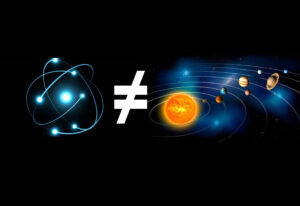
The notion of neutron stars as colossal atoms does not accurately represent this celestial phenomenon. While neutron stars share some similarities with atomic structures, such as their small size and incredibly high densities, the comparison between neutron stars and atoms is more of an analogy than a literal description. Neutron stars are not composed of protons, neutrons, and electrons arranged into atoms but consist of densely packed neutrons resulting from extreme gravitational forces that collapse the core of massive stars.
Some background
The concept of neutron stars dates back to the early 1930s when Walter Baade and Fritz Zwicky proposed the existence of a type of star composed entirely of neutrons. However, it was in the late 1960s that these stars were confirmed to exist. In 1967, Jocelyn Bell Burnell and Antony Hewish discovered regular radio pulsations emanating from an object they named “LGM-1” (Little Green Men 1) because of the possibility that the signal could be extraterrestrial communication. However, subsequent studies revealed that the signal was, in fact, a rapidly rotating neutron star, now known as a pulsar.
A pulsar is a highly magnetized spinning neutron star or white dwarf emitting regular electromagnetic radiation. Pulsars are believed to result from a supernova explosion that causes the star’s core to collapse, forming a rapidly rotating neutron star with an intense magnetic field. As the neutron star rotates, beams of electromagnetic radiation are emitted from its magnetic poles, which sweep across the sky in a lighthouse-like fashion, creating a regular pattern of pulses that telescopes on Earth can detect. The study of pulsars has provided essential insights into the nature of matter at extreme densities and the behavior of magnetic fields in the universe.
The formation of a neutron star occurs during a supernova explosion, which is the final stage of a massive star’s life cycle. When the core of a giant star runs out of fuel, it can no longer support its weight against the force of gravity, and the core collapses. As the core collapses, the density and temperature of the matter increase exponentially, and electrons and protons merge to form neutrons. This process results in a neutron-rich environment that produces a neutron star.
Not a black hole
It is not a consequence of luck that neutron stars do not become black holes. The mass of a star determines its fate after it exhausts all of its nuclear fuel. If the star has a mass of more than three of our suns, it will eventually collapse into a black hole. However, if the star’s mass exceeds three solar masses, the core will collapse into a neutron star. Therefore, neutron stars are the natural outcome of the evolution of massive stars with masses between 1.5 and 3 solar masses.
Neutron stars are still challenging to study despite being relatively close to Earth due to their small size and intense gravitational fields. The closest known neutron star to Earth is located in the Vela supernova remnant, approximately 1,000 light-years away from our planet. The Vela pulsar neutron star is one of the brightest sources of X-ray and gamma-ray emissions in the sky. Other nearby neutron stars include the Geminga pulsar, located about 800 light-years away, and the PSR J0108-1431 pulsar, about 770 light-years away.
Insane gravity
The surface gravitational force of a neutron star is extreme due to its massive density, and as a result, the weight of an average human on the surface of a neutron star would be incredibly high. To give the reader an idea, the surface gravity of a typical neutron star is about 2×10^11 times stronger than the gravity we experience on Earth’s surface. These disproportionate numbers mean that if an average human stood on the surface of a neutron star, they would be crushed by the immense gravitational force and likely be flattened to a height of only a few millimeters.
To calculate the weight of an average human on the hypothetical surface of a neutron star, we can use the formula for gravitational force, which states that the force of gravity is equal to the product of the masses of two objects divided by the square of the distance between them, multiplied by the gravitational constant. This incredible pull means that the force of gravity would be much more vital on the surface of a neutron star than on Earth. On the hypothetical surface of a neutron star, the distance between an average human and the star’s center would be only a few kilometers, which is incredibly small compared to the distance between an average human and the center of the Earth.
Assuming that an average human weighs around 70 kilograms, we can calculate their weight on the surface of a neutron star as follows:
Weight on neutron star = (mass of human) x (surface gravity of neutron star)
Weight on neutron star = 70 kg x (2×1011)
Weight on neutron star = 1.4×10¹³ kg
As the reader can see, the weight of an average human on the surface of a neutron star would be incredibly high, equivalent to trillions of kilograms. This immense gravitational force makes neutron stars fascinating objects to study and hazardous and inhospitable places for humans to visit.
Neutron stars are fascinating celestial objects that continue to captivate astronomers and astrophysicists with unique properties and behaviors. Neutron stars were proposed in the early 1930s, but in the late 1960s, they were confirmed to exist. Sadly for those who believed so, neutron stars are not giant atoms but share some similarities with atomic structures.
Indeed, several neutron stars have been named. These names were mostly given after their first discovery, the research team that discovered them, or in honor of famous scientists who made significant contributions to the study of neutron stars. One example is the Crab Pulsar, discovered in 1968 and named after the Crab Nebula, a supernova remnant in which it resides. Another example is the Vela Pulsar, which was found in 1968 as well and is named after the Vela satellite, which was used to detect gamma-ray bursts. Other named neutron stars include the Jocelyn Bell Burnell Pulsar, the first neutron star discovered, and the PSR B1919+21 Pulsar, also known as LGM-1, the first pulsar ever discovered.
In addition to these named neutron stars, many others are referred to by their catalog numbers. These catalog numbers are assigned by the International Astronomical Union (IAU) and are based on the pulsar’s position in the sky. For example, the Hulse-Taylor binary pulsar is officially known as PSR B1913+16, and the first-millisecond pulsar ever discovered is PSR B1937+21.
The formation of a neutron star occurs during a supernova explosion when the core of a massive star collapses, producing a neutron-rich environment that results in a neutron star. The fact that neutron stars do not become black holes is not a matter of luck but is determined by the star’s mass.
Verdict
So, no. Neutron stars are not mega-atoms. Nevertheless, they are still among the most exciting star types we know.


★ ★ ★ ★ ★
This is an original article published exclusively by Space Expert. You may cite it as:
"Are neutron stars mega-atoms?" in Space Expert, 2026
Permalink: https://space-expert/are-neutron-stars-mega-atoms/